Friday, 27 January 2012

Casting Information and Theory

It is important that when I cast for my characters I take into account narrative theories and show that I am assembling the correct common conventions in order for my audience to gain the best possible understanding of my characters. I want to achieve the broad character types in my production but at the same time I wish to pick people who can be unique and achieve the roles I wish for them to fulfill. Another important aspect I need to take into account is to get the correct representations of youth.

Using casting/character theory helps in researching and appreciates the structure of different roles in media characters.

Goffman’s (1959) character theory can help me sum up my youth characters I plan on casting and it can help me find a -

  • The Protagonist, the leading character of my film, referring to my script ideas I believe Youth 1 would take control as this character, although I plan on making this character possess a way of cruelty when looking at the conflict of villain/hero he would most certainly offer the leading defense of all three youths.
  • The Deuteragonist, the secondary character of my film, Youth 2 would fall under this character type, as he is the only other youth who offers enough narrative for my audience to understand this.
  • The Bit Player, the minor character whose specific background the audience is not aware of, finally in terms of youth characters it would be Youth 3, this minor character is displayed clearly as I plan to have him as a smaller build to the others who takes orders and also is shown attacked at the end of the trailer.
Propp’s (1969) character theory can help me further sum up my character and content of my production-

  • The Villain, this can clearly define my antagonist Rick Strangle, as a character type he needs to have a certain fear factor about them and also be willing to experiment with a range of costume/make up designs.
With all my characters now defined under certain character theory, my casting needs to take into account all these characterizations but at the same time I do need to twist some generic conventions to benefit my audiences needs and create something unique.


Production: Blog Update

During the run up to my exam for media, my blog has received less attention but as I come to an end of the pre-production package I have now got to scan in my storyboards and make sure all my casting, location choices are justified before I begin my production. I am looking forward to starting the production very soon and allowing myself enough time to go through the editing process professionally. 

Thursday, 26 January 2012

Lighting in Film

Filmmaking does rely on capturing light as it can be used to assist the meaning of the production. Light in film can be produced by; the sun, the moon, existing light sources or using powerful artificial light. The way the scene or shot is lit does influence the audience’s gratifications.

The lighting can also help the audience understand the production values and quality, therefore it is important for me in my production to make sure the light is well placed and planned. By doing this I can avoid my viewers thinking my production is amateur. It also possible to consider lighting in terms of genre, for example Documentary’s use natural light so it connotes to the audience. Horror genre would use torchlight or something to connote fear.

Allen Daviau said "why we hate multiple cameras: because we light differently for close-ups." This is a quote from the book ‘Twenty-one Cinematographers at Work’; this makes it clear to me that I need to consider separate lighting for each camera shot if I am using multiple shots simultaneously, this way I can get the correct lighting.

High Key Brightness
There are different elements of lighting:

Brightness- the biggest difference when it comes to brightness selection is high and low key brightness with a mutual mid-key brightness.  Yielding average brightness is mid-key lighting. Brightness can be used to depict the drama of the scene. High key is preferred in a scene when there is a lot more action where as low-key lighting should ne applied to a stretched slow drama scene. In terms of my production I should look to be using high-key brightness that connotes high-speed action and tension, which is part of what I am trying to achieve in my film trailer.

Contrast- the specific meaning behind contrast is the balance of pure white and black tones in a piece of footage/image. Low contrast appear easy to the eye where as high contrast is sharp and uses a more diverse range. The use of high contrast is used in other real media examples to heighten drama and allow the audience to have a better understanding.

Quality of light- this can be defined through hard or soft light, the hard quality light features dark shadows with very sharp shadows whilst soft light gas diffused shadows. In my production blending the two in different scenes to create Claude Levi Strauss’s binary oppositions could be used.

Focus- this is the overall sharpness of an image; altering the focus levels can create a very soft or sharp image. The depth of field can further measure focus; different lenses can produce different depths of field. There can be both shallow and deep focus.

Deep perspective
Perspective- I must ensure that the depth is not decompressed in order for my footage to appear sluggish and slow, as the generic conventions of my genre require some fast paced shots that is achieved through a deeper perspective.

Color- otherwise known as hue can be manipulated through lighting, shooting in color which applies to me of course allows for more aesthetic variables so I need to take into consideration overall hue, the means a scene can be tinted, for my production I will consider using a dark blue tint which will give me the sinister horror effect. This would be considered a cool hue.

Monday, 19 December 2011

Shot List for my Trailer

My shot list I have constructed will help me in the planning and filming for my trailer. The more planning and preparation I put into my film the more successful my audience will interpret it.

Here is my shot list for 'The Proprietor'.

Saturday, 17 December 2011

My Film Trailer Script.

I  have now composed my Film Trailer script and was able to do so by succesfully annotating my script style models. This helped me understand the correct layout and how to efficiently script for a production. Having done this I could include camera movements, angles, shots and various other script technqiues to provide me with a clear final script which would satisfy my audiences needs.


The Proprietor.

FADE IN:

1. ROADSIDE- DAY

A car pass’s the road from a LOW ANGLE view.
The LOW ANGLE view then focus’s on TEEN1 who is dealing with a flat.
VOICE OVER:
TEEN1:
We got a flat man!
CLOSE UP on TEEN1 inhaling a cigarette.
TEEN1:
And I can’t fix this!
FADE OUT.


2. ENT- WOODS- DAY

PAN the WOODS…
VOICE OVER:
TEEN 2:
I got no bars!
TEEN1:
We can take the shortcut across the woods!
OVER THE SHOULDER shot TEEN2 – TEEN1…
TEEN 2:
Im not so sure man, iv heard things about Strangle Woods!
TEEN1:
That’s ridiculous and who knows, we may just make a night of it.
TEEN1 smirks – FOCUS ZOOM.
CUT TO.

3. ENT- INSIDE WOODS- DAY

CLOSE UP on a ROCK.
One by one each of the three teenagers walk over the rock just capturing the LOWER LEG.
VOICE OVER:
TEEN1:
RICK STRANGLE! That old myth.
Gradually we begin to hear echoed laughter in the BG.
After this there is a FADE OUT and a FADE in and a shot of the VILLAIN’s foot walking over the same rock. EDIT this TRANSITION to signify the VILLAIN.
START NON DIEGETIC SOUND- Suspense Track.
CUT TO.


4. ENT- CAVE- DAY.

LONG SHOT on TEEN(S) with CAVE in the BG.
TEEN2:
I need a break dude, we don’t know where we are.
TEEN1:
No breaks! You hear me!
TEEN1 throws a cigarette to the entrance of the cave in the BG.
TILT SHOT from the CIGARETTE to the VILLAIN standing in the CAVE.
ZOOM in on AXE and SLOW MOTION edit it being rotated in VILLAINS hand.
CUT TO.


5. ENT- WOODS- DAY.

MEDIUM SHOT, CAMERA follows TEEN2 and then stops when TEEN2 turns around.
TEEN2:
What was that?
(PANTING)
TEEN1 enters the shot.
TEEN1:
Its nothing!!
CUT TO.


6. ENT- TREE- DAY


TEEN3 is seen in a MEDIUM CLOSE UP and paces away from the CAMERA, VILLAIN then emerges behind the villain from the tree and a BLUR EDIT is applied whilst VILLAIN raises the AXE.
EXIT NON DIEGETIC SOUND- Suspense track.
DIEGETIC SOUND: SCREEM from TEEN3.
CUT TO.


7. ENT- INS CAVE- DAY

TRUCKING MOVEMENT in the CAVE with VILLAIN 2 holding lit lighter with VILLAIN smiling behind there is only NON DIEGETIC panting SOUND.
CUT TO.


8. ENT- WOODS- DAY

VILLAIN drops AXE onto a log.
FADE OUT.

Thursday, 15 December 2011

Film Script Style Models

In order to produce an accurate script for my film I will annotate some iconic horror film scripts. By looking at a few and establishing some common codes and conventions I can apply them to my work and therefore better my production resulting in my audience being more satisfied and meeting there needs.

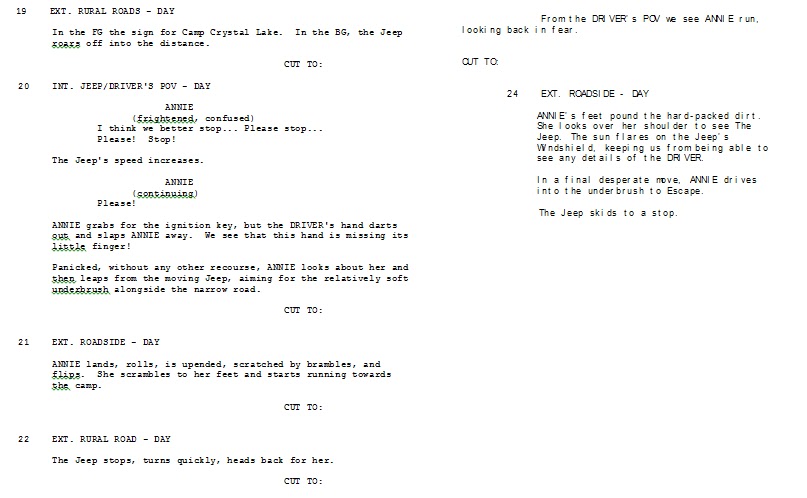
Friday 13th.


This is part of the script for the original Friday 13th scripted by Victor Miller. First feature I noticed about the script was that it had numbered each shot to make the script be interpreted easily and it comes across as more organized. The tittle and description of the shot is also included in the script, i.e. EXT. ROADSIDE, there is a lot of use of abbreviations in the script, which must be used for convenience to the scriptwriter. Names are also seen in capitals for e.g. ANNIE, this is so names can be easily picked out in the script. Setting is included in the script and each shot number is also given a DAY/NIGHT mention this is especially important in Horror films as the transition between night and day can be decisive in effect to the audience, this needs to be clearly stated because certain shots will only take effect when particular Mise-en-scene is present. There is also use of ellipsis in the script to represent silence or a pause before/after speech.  Abbreviations also represent media terminology, for instance POV (point of view) and BG (back ground).

Haloween.


This script was written by John Carpenter and Debra Hill. This script shows a lot more detail towards the content for instance, ANGLE on [Subject] helps the script be easily interpreted and also the names are in CAPITAL letters to easily distinguish the different names. This script also uses abbreviation such as POV. Capital letters also symbolize emphasis on certain parts of the script, i.e. ‘SLAMS’. In contrast to the Friday 13th script, this one shows a lot more direction for the production team and allows each part to be easily understood.

Tuesday, 6 December 2011

Film Treatment


When this feature films hits the screens a new horror villain is installed to the hall of fame, an antagonist never seen before.

The trailer for my film ‘The Proprietor’ is a slasher horror film that follows a deluded psycho (Rick Strangle) in an evil picturesque setting where he aims to torment and finally kill the same youth stereotype, which killed his family long ago, throughout we see a character with emotion and a story that the intended audience will interpret in there own way.

We see it all begin in a setting with elegance but not before long the trailer shows the intruders of the woods, the youth characters are represented as your typical hoodlums and before long ‘The Proprietor’ notices the intrusion.

Shot by shot we start to see more of ‘The Proprietor’ and begin to create an understanding of appearance.

The reluctant youths pursue their denial of the many different tales to come out of Strangle woods and before long we see the attitude of the youths and their destructive manner. Lead youth character AJ dominates the dialogue between the youths to represent him as the youth with power.

We then begin to realize ‘The Proprietor’ lurks very close and by surrounding the youth the power focus alters to the antagonist.

The particular focus of my trailer is to deliver a fluent production which impacts my audience, in order to do this I will shadow the Uses and Gratifications theory in the way it gives my target audience 15-24 a chance to gain social approval from seeing my film, I need to challenge the question ‘what people do with media?’ (Katz 1959)  By doing this I can include features which will gratify my audience in their every day life. My initial thought into achieving this is offering my film as a product of social trend, as a young adult myself I can confidently say that to watch an elite horror film is somewhat an essential as there is often conversations subject to the film when there is a big market hype.

The inspiration for this film came from my passion for horror films and the knowledge of many different sub genres horror holds, in order to ensure myself that I would enjoy and gain the best possible grade for my production I needed to layout specific planning regarding audience and generic conventions and more. After gaining further knowledge of the genre horror I enabled myself to explore new ideas and this made me even more enthusiastic about what I could achieve.

The trailer has all the makings for psychological suspense combined with well fashioned characters in Rick Strangle (The Proprietor) and AJ.

As part of my Photography studies I am in the planning stages of organizing a film mentor for that project, who has had associations with BAFTA nominees and many other professionals. I am hoping the knowledge I acquire will help me with this project significantly. This will help me come closer to achieving a top grade in the production.

The shots I will use in the film trailer will vary; I will be able to establish a better idea once my storyboard is complete, at the moment though I have obtained various sources, which show me the common conventions of horror camera movement.

The budget for my film will be limited although the current ideas I have do not tell me I need to spend too much money, all props and equipment will be coordinated into the budget I have. Funding of the budget very much relies on my own money. If necessary I could seek for sponsorships and fund raising events.